
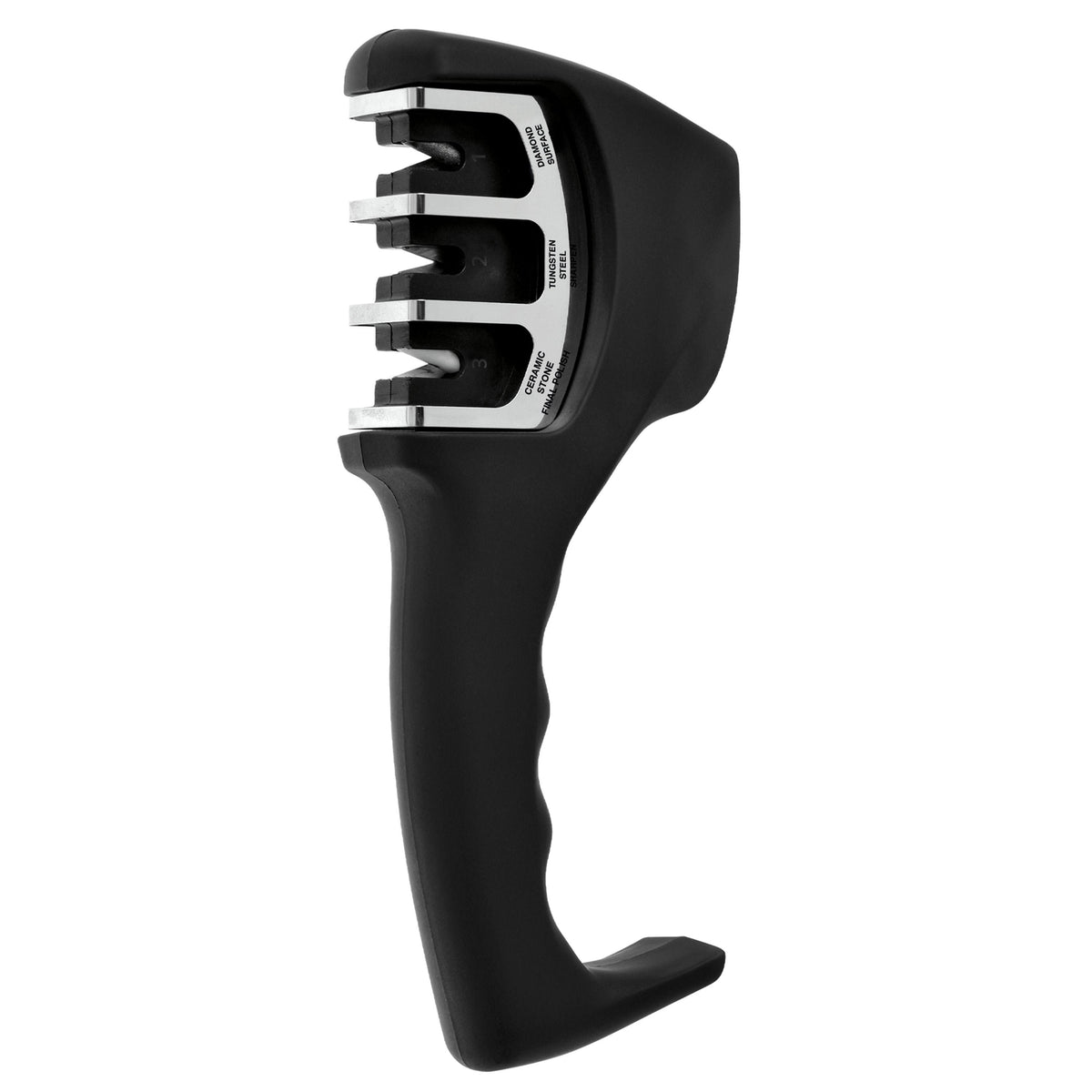
Quick answer: for most home cooks, the easiest way to keep kitchen knives sharp is a two- or three-stage pull-through sharpener: draw the knife through the coarse slot a few times, then through the fine slot. Use a honing steel or the fine slot every week or two to keep the edge straight, and sharpen properly only when honing no longer helps. If you want the finest edge and do not mind practising, a whetstone gives you the most control.
This guide explains the difference between honing and sharpening, how to use each tool step by step, which angle to keep, how often to sharpen and how to make the edge last longer.
Honing vs sharpening: what's the difference?
These two words are often used as if they mean the same thing, but they do different jobs.
- Honing straightens the edge. With use, the very thin edge bends slightly to one side, and the knife feels dull even though little metal is gone. A honing steel or a fine ceramic slot pushes the edge back into line. It removes little or no metal.
- Sharpening grinds away a small amount of metal to create a new edge. You need it when the edge is rounded or nicked and honing no longer brings it back.
In practice: hone often, sharpen rarely.
Which sharpening tool should you use?
| Tool | Best for | Ease of use | Things to know |
|---|---|---|---|
| Pull-through sharpener (2–3 stages) | Quick, regular sharpening at home | Very easy | Angle is fixed by the slot; not for serrated bread knives |
| Whetstone | The finest edge, full control | Needs practice | You hold the angle yourself; the stone must be soaked or wetted |
| Honing steel | Keeping the edge straight between sharpenings | Easy after a few tries | Does not repair a blunt or nicked edge |
| Professional service | Damaged blades, serrated knives | No effort | You are without your knife for a while |
How to use a pull-through knife sharpener
A pull-through sharpener has slots with abrasive surfaces set at a fixed angle, so you do not have to hold the angle yourself. That is why it is the easiest choice for most kitchens.
- Place the sharpener on a flat, dry surface and hold the handle firmly. A non-slip base keeps it steady.
- Start in the coarse slot if the knife is really dull. Place the heel of the blade in the slot and pull the knife towards you in one smooth stroke to the tip. Use light pressure and do not push down hard.
- Repeat 4–6 times, always in the same direction.
- Move to the fine slot and repeat 4–6 times to polish the edge and remove small burrs.
- Wipe the blade with a damp cloth to remove metal particles, then dry it.
- Test the edge by slicing a sheet of paper or a tomato. It should cut cleanly without tearing.
The Essentials 3-stage knife sharpener uses a diamond surface to prepare the blade, tungsten steel to restore the V-shaped edge and a ceramic stone to polish it. The Leo 2-stage knife sharpener has a coarse slot that prepares the edge and a fine slot that polishes it, with a soft-touch handle and non-slip base. Both are hand wash only. See all knife sharpeners.
How to sharpen a knife on a whetstone
A whetstone takes more practice, but it lets you control the angle and the finish. Stones are graded by grit: a coarse grit (for example around 400) repairs a very dull or chipped edge, a medium grit (around 1000) is used for normal sharpening, and a fine grit (3000 and up) polishes the edge.
- Prepare the stone. Soak or wet it according to its instructions and place it on a damp cloth so it does not slide.
- Find the angle. Hold the blade against the stone at roughly 15–20°. A simple trick: 90° is upright, half of that is 45°, half again is about 22° – then tilt a little lower.
- Sharpen one side. With light pressure, push the blade across the stone from heel to tip, as if slicing a thin layer off the stone. Repeat 10–15 times.
- Check for a burr. Carefully run a fingertip across (never along) the opposite side of the edge. A slight rough lip means you have sharpened far enough on that side.
- Sharpen the other side the same number of strokes.
- Finish on a finer grit, using fewer and lighter strokes, then rinse and dry the knife.
How to hone a knife
- Hold the honing steel vertically with the tip resting on a cutting board.
- Place the heel of the knife against the top of the steel at about 15–20°.
- Draw the blade down and towards you, so the whole edge from heel to tip touches the steel.
- Alternate sides, 4–5 strokes per side, with light pressure.
If you do not have a honing steel, the fine slot of a pull-through sharpener does a similar job.
Which angle is right for kitchen knives?
Most Western-style kitchen knives are sharpened at around 15–20° per side. A lower angle gives a keener edge that cuts more easily but may dull faster; a higher angle gives a sturdier edge. Japanese-style knives such as many santoku knives are often sharpened at a slightly lower angle. When in doubt, follow the knife manufacturer's guidance and keep the angle consistent – consistency matters more than the exact number.
How often should you sharpen kitchen knives?
| How much you cook | Hone | Sharpen |
|---|---|---|
| Every day | Every few days to weekly | Every 1–3 months |
| A few times a week | Every 1–2 weeks | Every 3–6 months |
| Occasionally | Before use if it feels dull | Once or twice a year |
The simplest test: if the knife slides off a tomato skin instead of cutting into it, it is time to hone or sharpen.
Which knives should not go in a pull-through sharpener?
- Serrated knives, such as bread knives. The teeth need a special tapered rod or a professional service.
- Single-bevel knives, which are sharpened on one side only.
- Knives with a damaged tip or large chips – these need coarse whetstone work or a professional.
How to keep your knives sharp for longer
- Use the right board. Wood, bamboo or plastic boards are kind to the edge; glass, stone and ceramic plates dull it quickly. See our cutting boards.
- Wash by hand. Most knives, including BergHOFF chef's knives, are recommended for hand washing. In a dishwasher the blade can knock against other items.
- Dry straight away and store knives in a block, on a magnetic strip or with blade guards – not loose in a drawer.
- Do not scrape food off the board with the edge. Turn the knife over and use the spine.
- Use each knife for its job. A chef's knife is not for cutting frozen food or bones.
A sharp knife starts with a good blade. The Gene chef's knife 20 cm, for example, has a forged, hand-sharpened stainless steel blade. Browse all chef's knives, or read our kitchen knives guide to see which knives you really need.
FAQ
What is the best knife sharpener for home use?
For most home cooks, a two- or three-stage pull-through sharpener. It is quick, safe and keeps the angle for you. A whetstone gives a finer edge but takes practice.
Is honing the same as sharpening?
No. Honing straightens a bent edge and removes little or no metal; sharpening removes metal to create a new edge.
What angle should I sharpen my kitchen knife at?
Around 15–20° per side for most kitchen knives. Keep the angle consistent on both sides.
Can I sharpen a serrated bread knife?
Not in a standard pull-through sharpener. Use a tapered sharpening rod or a professional service.
Why does my knife get dull so quickly?
Usually because of hard cutting surfaces, the dishwasher, or storing knives loose in a drawer.
How do I clean a knife sharpener?
Tap out metal dust and wipe the sharpener with a damp cloth. BergHOFF sharpeners are hand wash only.